How Cigar Importers Make Cuban Regional Cigars
Decades before Habanos coined the term “Edición Regional,” Cuba’s factories were already turning out bespoke Cuban cigars for elite shops and special events—unique smokes that today’s collectors treat as the first true limited-edition Cuban cigars.
The best-known collaboration was with Alfred Dunhill Ltd. In post-war London, the retailer convinced Cubatabaco to re-band Montecristo and Por Larrañaga vitolas with the white-on-claret “Dunhill Selection” label. Produced intermittently from the late 1940s to the mid-1970s, these Dunhill Cuban cigars met exacting draw and colour specs, shipped in cedar cabinets stamped “Made expressly for Dunhill,” and never left the company’s Duke Street or New York boutiques. They were not a stepping-stone to the modern Regional programme; they were simply retailer-funded one-offs that proved Cuba would tailor cigars for clients powerful enough to finance the run.
Switzerland enjoyed its own pre-Regional moment when Genevan tobacconist A.G. Müller commissioned short batches of Por Larrañaga Perfectos for Zürich duty-free counters in the early 1960s. Canada followed suit when Holt Renfrew stocked Royal Household cigars banded for diplomatic salons. None of these projects had minimum volumes, approval cycles or territorial embargoes: they were handcrafted orders, fulfilled and forgotten once the ledger closed.
Fast-forward to 2002 and the Bolívar Sentinel robusto—just 150 numbered boxes rolled for a London charity dinner at Boisdale—now a grail item for aficionados hunting the rarest limited-edition Cuban cigars. Like the Dunhills, it carried no second band, no serial sticker, and none of the brand, size or exclusivity rules that define today’s Regional Editions. Together, these one-off collaborations form a crucial, if often overlooked, chapter in Cuban cigar history, showing that tailor-made luxury smokes existed long before Habanos offered every national distributor a formal, rule-bound programme.
Regional Edition Became Official in 2004
The idea moved from casual conversation to hard policy at Habanos S.A.’s distributors’ meeting in Havana, June 2004. Under the pilot, any participating importer could commission a cigar from the Portfolio (non-Global) brands, so long as three safeguards were met: the cigar had to use a factory size that brand had never sold, the entire run—25 000 cigars—had to be paid for up front, and the finished boxes would remain exclusive to the home market for at least twelve months. Four veteran importers accepted the terms, but only three of their cigars actually reached retail before the year closed:
- Punch Robusto for Switzerland
- Punch Superfinos for Italy
- Ramón Allones Belicoso for the United Kingdom
The Swiss and Italian releases wore a plain silver-on-red strip that read simply “Edición Regional.” The British cigar was different: Hunters & Frankau’s Belicoso left the factory with no secondary band at all, making it the lone single-band Regional of the pilot batch. None of the boxes carried serial numbers. Demand was instant—Hunters & Frankau’s 2 500-box allocation sold out in forty-eight hours—convincing Habanos to institutionalise the scheme for 2006.
By 2008 the company had refined the presentation, upgrading the generic strip to the familiar red-and-silver “Exclusivo <Region>” band and mandating numbered boxes. For a brief window (2008-11) distributors were even allowed two Regionals per year. Yet those first three cigars—the Swiss Punch Robusto, the Italian Punch Superfinos, and the UK Ramón Allones Belicoso Fino—remain the Programme’s ground zero, proof that a prepaid, country-exclusive Cuban could ignite local pride and global envy in equal measure.
The Process of Making a Regional Cuban Cigar
Each March Habanos emails a spreadsheet of eligible brands—Global flagships and short-filler lines are barred, and any marque slated for a global launch is “blocked” for the year. Distributors must also obey a rotation rule: a brand cannot recur until four other marques have appeared in that country’s Regional line-up.
The Formal Proposal
The importer submits a dossier—brand, factory size (vitola de galera), commercial name (vitola de salida), packaging format and any extras such as an anniversary sub-band. Approval triggers a single invoice for the full 60 000-cigar order, which must be wired to Havana before the first leaf is stripped. Canadian importer Havana House calls the pre-payment “the ultimate commitment device—there’s no turning back once the money moves.”
The Blending Stage
Cuba’s blending team rolls three trial cigars. Hunters & Frankau assembles tasting panels of staff, retailers and club members; Intertabak defers to Tabacuba’s expertise (“we trust the Cubans to nail the profile”); Havana House runs a hybrid panel with sommeliers from Montréal. Once a blend wins, the recipe is locked.
Rolling, Banding & Packaging
Habanos assigns a factory—usually the plant linked to the brand unless capacity or special-shape expertise dictates otherwise. Every cigar receives the marca band plus the mandatory red-and-silver strip reading Exclusivo and the region’s Spanish name (Suiza, Gran Bretaña, Canadá). Boxes—varnished cab, dress or slide-lid—are serial-numbered and stamped with factory/date codes; holographic warranty seals complete the package.
The Regional Cigar Rule-Book
Habanos runs the Edición Regional programme under a strict, published framework that leaves little room for improvisation. Only non-Global, long-filler brands may be used; importers must pre-pay for the full production run and live with a one-cigar-per-year quota. Sizes can’t duplicate anything already in that brand’s catalogue, and every finished box must carry both a red-and-silver Exclusivo band and an individual serial number. The distributor enjoys a full year of home-market exclusivity, after which the cigars may circulate worldwide.
Current Rules (quick list)
- Eligible brands: long-filler Portfolio marques only
- Brand rotation: four different marques before a repeat
- Vitola: must exist in factory chart but be new to that brand
- Minimum order: 60 000 cigars, prepaid in full
- Annual quota: one Regional per market per calendar year
- Proposal window: March–May for the following-year release
- Prototype stage: Cuba sends three blends; importer chooses one
- Factory: assigned solely by Habanos/Tabacuba
- Packaging: dual bands and serial-numbered boxes (post-2008)
- Exclusivity: 12-month monopoly inside the distributor’s territory
La Flor de Cano
La Flor de Cano was introduced in Havana in the early 1930s for the Spanish market, a mid-priced line built almost entirely on short-filler, machine-made cigars. The brand’s enduring popularity had two drivers: Spain’s weight-based import tax rewarded slimmer, lighter sticks, and Vuelta Abajo leaf was scarce in Europe during the Depression. For decades Flor de Cano thrived as the affordable foil to handmade Partagás and Montecristo.
In 1984, Cubatabaco floated a strategy to give selected machine-made marcas a premium halo. Flor de Cano received three test vitolas—Churchill, Corona and Petit Corona—rolled “totalmente a mano, tripa larga.” They earned strong reviews in Switzerland and Hong Kong but never graduated to full production; the global handmade boom of the 1990s left the experiment in limbo, and by 2000 the marca existed mainly as a duty-free catalogue item.
Habanos’ rule-book bans short-filler brands from Regional Editions, but it makes one allowance: if the proposed cigar is rolled as long-filler with a standard factory size, the marque is treated as a portfolio brand for that project. Hunters & Frankau exploited this loophole in 2010, commissioning the Flor de Cano Short Robusto—the first handmade Flor de Cano of the twenty-first century and the first U.K. Regional not tied to a marquee powerhouse like Bolívar or Ramón Allones.
Flor de Cano and the U.K. timeline
- 2010 Short Robusto (4 × 50, 50 000 cigars) revived the marque; boxes sold out within six weeks.
- 2013 Gran Cano (5 ½ × 50, 5 000 SLBs, 50 000 cigars) marked the first use of a factory name as the commercial title for a U.K. Regional.
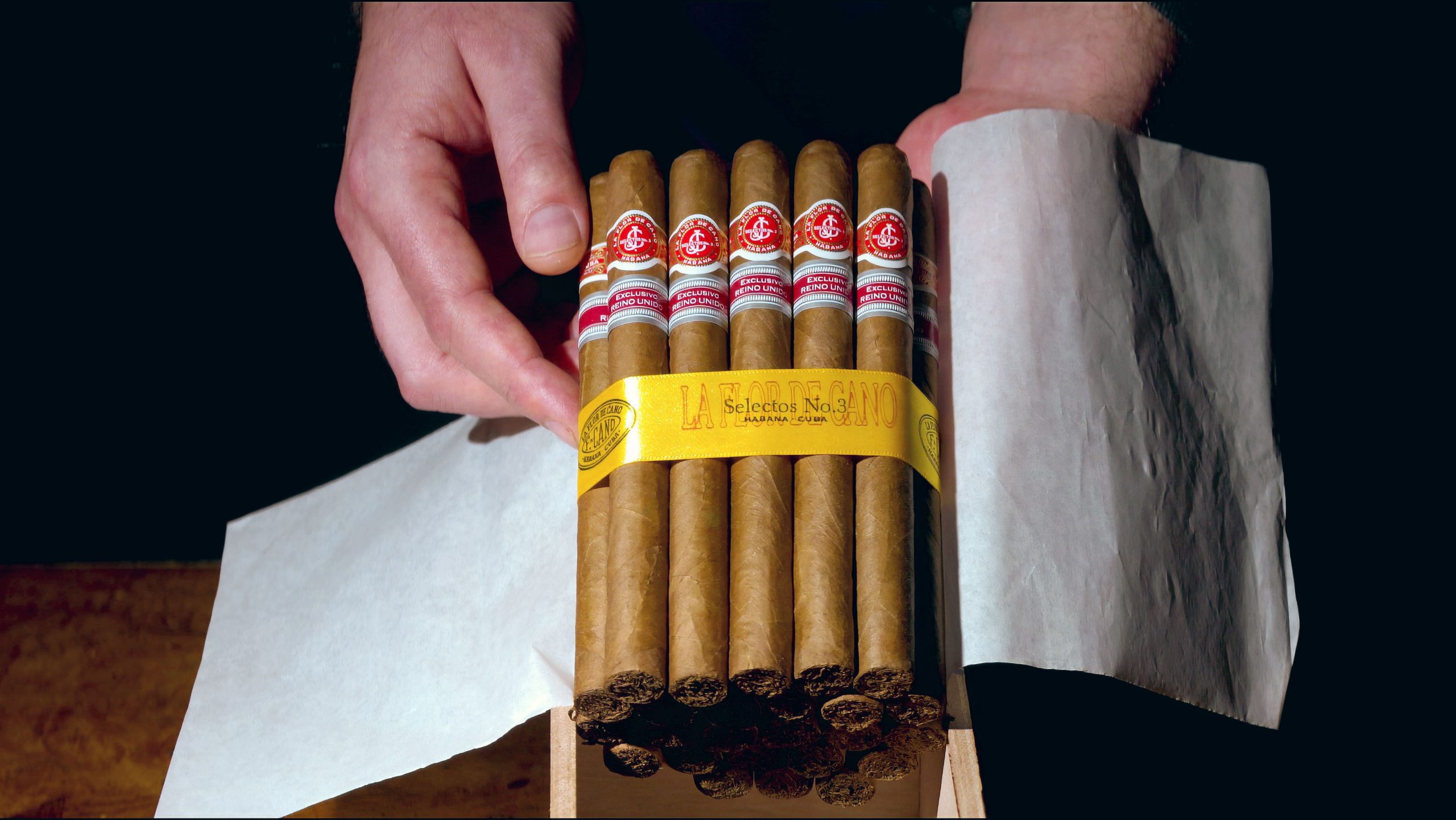
- 2025 Selectos No. 3 completes a de-facto trilogy and secures Flor de Cano’s status as a house favourite for British exclusives.
The new Selectos No. 3
- Vitola Cervantes (6 ½ in × 42 RG)
- Blend 100 % long-filler Vuelta Abajo; medium body, sweet cedar start, white-pepper finish
- Packaging 5 000 numbered slide-lid boxes of 25 (total = 60 000 cigars)
- Launch 7 February 2025; U.K. RRP £42.50 per stick
- Band text “Exclusivo Gran Bretaña” in line with post-2012 nomenclature
Flor de Cano’s Regional releases illustrate how the programme can rescue a near-dormant marque and pivot it from budget workhorse to connoisseur collectible. They also prove that Habanos’ rules—while strict—contain enough flexibility to let importers showcase forgotten brand DNA, provided the cigars meet long-filler standards and the 60 000-unit, pre-paid floor.
With Short Robusto, Gran Cano and now Selectos No. 3, the U.K. has effectively steered Flor de Cano’s twenty-first-century narrative, turning a once machine-made cigar into a sought-after limited edition with ageing potential.
Final Thoughts
The Edición Regional programme works because the rules are clear: only one cigar per country each year, a fixed 60 000-stick order, and numbered boxes that prove authenticity. Country exclusivity makes the cigars hard to find; the serial numbers help collectors track them.
If you’d like more detail, watch our 90-minute livestream below. Maisie and I talk through the process while smoking the new Flor de Cano Selectos No. 3. We compare notes from Ana López, ask Intertabak about Swiss lead-times, and explain how Canada handles plain-pack laws. The video adds practical examples and a live tasting to the facts you’ve just read.