TobakkoNacht – The Antismoking Endgame
“This notice is to inform you that due to a recent change in our apartment policy, you must cease and desist smoking, or vacate the premises within 30 days. We know that you have been living here in our complex for the past fifteen years, and you are a valuable resident. Unfortunately, our tenants have complained, and there is nothing we can do.”
How many times have you received a notice like that? Or been told that you cannot hold a job because you smoke, or even that you will lose a relationship if you do not decide to give up your cigars, cigarettes, or pipe? Any cigar aficionado has gone through an experience like this at least once, if not numerous times. Even if it hasn’t happened to you yet, it is more or less a guarantee that it will eventually.
It’s important to be free to choose the lifestyle that we want. Over the years, tobacco smokers have seen their rights systematically stripped away or threatened. Usually when policymakers bring up a new tobacco law, they cite health concerns as the basis. Friends, family members, landlords, and employers typically do the same. Have you ever wondered about where those statistics come from and what they mean?
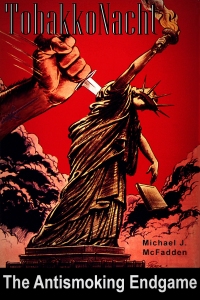
Michael McFadden is a graduate of the statistics and propaganda analysis program offered by the University of Pennsylvania. Since graduating, he has worked to promote social change through peaceful activism. He is well known for a previous publication, Dissecting Antismokers’ Brains. His new book, TobakkoNacht (available Amazon), further dissects the statistics which are promoted as facts by antismoking campaigners.
Here are some examples:
One type of statistical aberration McFadden talks about is the “almost zero” logical fallacy. Many statistics about smoking involve comparisons between environments with toxins from cigarette smoke and environments without them. A study may show that there is “53 times as much of the toxin” in the smoking environment, which then frightens the reader. But if the non-smoking environment contains almost zero of that substance, 53 times that amount is still very, very little, and may even be within a safe range.
 Another great example is an antismoking study conducted by Dr. Nogueira-Filo et al. called “Low- and High-Yield Cigarette Smoke Potentiates Bone Loss During Ligature Induced Periodontitis.” This study was cited repeatedly by anti-smoking campaigners as a basis for stating that gum disease is caused by secondhand smoke in any amount. What the campaigners failed to mention was that the study was conducted on rats, and that the rats were repeatedly placed in a single cubic foot of space while smoke from cigarettes was pumped in three times a day. This is equivalent to burning almost a thousand cigarettes in a phone booth measuring eighty cubic feet. To top it off, the scientists had torn abrasions in the rats’ gums. The gums were struggling to heal while the rats were subjected to the repeated torture, after which they were put down and dissected. Not only is this an absurd comparison to a standard “smoking environment,” but are these really the kinds of people you want lecturing you on health or morality?
All of this isn’t to say that smoking tobacco has no effect on your health, or that secondhand smoke has no effect either. But you should do your own research and understand where statistics come from before you put your faith in them. The fact is, a lot of what is out there (from both sides unfortunately) is misinformation. It is politically and economically motivated, and smoking is just the beginning. What’s next? Soda? Meat? It may sound paranoid, but take a look at an ingredients list on a food package sometime and start trying to understand what does and doesn’t go into the food you eat and the beverages you drink. It’s shockingly challenging.
Misinformation is rampant in modern life; that might be one of the only facts which is easy to distinguish. Moderation is a good thing when it comes to any personal habit—too much soda isn’t good for anyone, and neither is too much tobacco. But most smokers aren’t shutting themselves up in telephone booths with thousands of burning cigarettes. And if you’re a cigar smoker who simply enjoys an artfully crafted stogie now and again, you owe it to yourself to understand the health risks your habits do and do not impose based on the information which is actually out there. TobakkoNacht is a good start, and once you’ve read it, you’ll be ready to participate intelligently and thoughtfully in any debate about the effects of tobacco.
Quick links: you can find some excerpts on the official website, or purchase the book from Amazon ($27.95)